Neonatal & Pediatric Respiratory Equipment
Objectives — Identify basic facts and terms about transcutaneous monitoring, nitric oxide delivery systems, and incubator operation, and employ basic respiratory therapies to neonatal and pediatric patients.
Transcutaneous Monitoring
Transcutaneous blood gas monitoring allows constant monitoring of the patient's PaO₂ and PCO₂ without continuously drawing blood gases. Unlike normal saturation monitors, transcutaneous monitors "see" both PaO₂ and PCO₂, measured as PtcO₂ and PtcCO₂.
They differ from saturation monitors in another key way: they heat the skin to arterialize the capillaries beneath it, increasing skin permeability to O₂ and CO₂ so the gases diffuse more readily to the sensor.
| Factor | Effect |
|---|---|
| Age & perfusion status (vasoconstriction, dehydration, low cardiac output) | Directly impact measurement accuracy |
| Premature infants / neonates / children | Greatest accuracy — due to skin composition, easier to detect changes |
Indications & Cautions
- Indications: hemodynamically stable patients needing PaCO₂ monitoring who have issues collecting blood or low Hb counts; diagnostic use for functional shunts or response to an oxygen challenge to determine congenital heart disease.
- Contraindications/precautions: thermal damage from heating — reposition the electrode every 2–6 hours; stabilization can take up to 20 minutes after moving the electrode; false negatives leading to false treatment; values must be trended against blood gases; readings can vary > 10% even with proper placement (not 100% reliable).
Inhaled Nitric Oxide (iNO)
Nitric oxide is a selective pulmonary vasodilator used to treat newborns who require mechanical ventilation primarily for hypoxic respiratory failure. It works by improving shunts: the body naturally constricts pulmonary vasculature local to poorly ventilated/oxygenated alveoli, and by vasodilating constricted capillaries around healthy alveoli, iNO overcomes the shunting. It improves oxygenation and reduces the need for ECMO.
| Parameter | Value |
|---|---|
| Normal starting dose | 20 PPM |
| Therapeutic range | 2–20 PPM |
Indications
- Hypoxic respiratory failure
- Term/near-term neonates (> 34 weeks) with PPHN
- Gradient between preductal and postductal SpO₂
- Congenital diaphragmatic hernia
- Oxygenation index (OI) > 25, where OI = (Paw × FiO₂) / PaO₂
Weaning & Toxicity
- NO combines with oxygen to form the much more toxic nitrogen dioxide (NO₂) — keep below 2 PPM.
- iNO can form toxic molecules like peroxynitrite that damage tissue.
- Wean by 50% down to 1 PPM, then discontinue. Increase FiO₂ as iNO is weaned to prevent rebound hypoxemia and a return to PPHN.
- Monitor methemoglobin (NO + oxyhemoglobin → ferrous Hgb that can no longer take up or release O₂). Keep < 5% of total Hgb.
ECMO
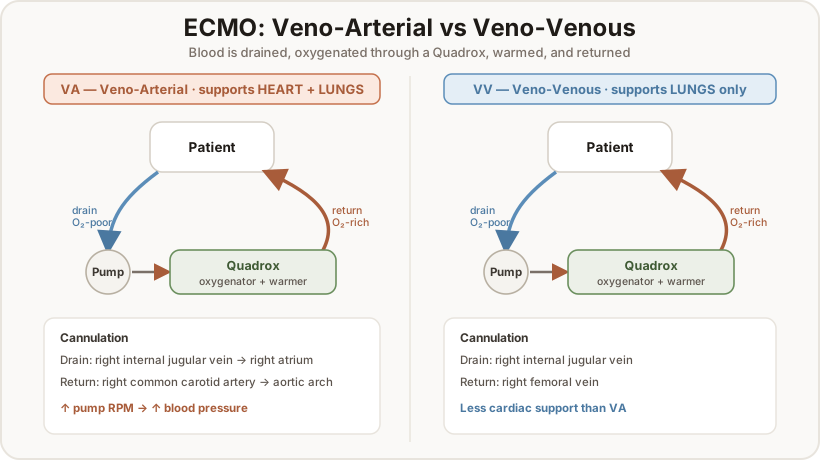
Extracorporeal Membrane Oxygenation — a modified form of cardiopulmonary bypass used for relatively long-term pulmonary or cardiopulmonary life support when maximum medical intervention has failed. Blood is pumped through an artificial lung called a Quadrox, oxygenated, warmed, and returned to the body.
| Type | Support | Cannulation |
|---|---|---|
| VA — Veno-Arterial | Both heart and lung | Cannula in the right internal jugular vein → right atrium; cannula in the right common carotid artery → aortic arch |
| VV — Veno-Venous | Lungs only (less cardiac support) | Cannula in the right internal jugular vein and the right femoral vein |
On VA ECMO, higher pump RPMs can produce a higher blood pressure.
Incubators & Radiant Warmers
Most NICUs are equipped with radiant warmers and isolettes (incubators). The beds can deliver oxygen, suction, and heat.
| Device | Best for |
|---|---|
| Incubator / isolette | A quiet, isolated environment to "feed and grow"; great for exact temperatures, but difficult to access the patient in emergencies |
| Radiant warmer | Initial or late-stage transport; an open environment to manipulate the patient and perform CPR; the standard unit in delivery rooms (can attach oxygen canisters) |
RCP's role: primarily to stock and maintain supplies in the drawers beneath the beds — suction, blades, nasal cannulas, ambu bag with mask, heat probe, saturation probe, and towels.
Oxygen Delivery Devices
Endotracheal Tube Sizing
| Estimate | Formula |
|---|---|
| Tube ID (by age) | (Age + 16) / 4 |
| Tube ID (by height) | Height (cm) / 20 |
| Tube length (oral) | 12 + (Age / 2) |
| Tube length (nasal) | 15 + (Age / 2) |
Device Comparison
| Device | Age / population | FiO₂ & flow | Notes |
|---|---|---|---|
| Nasal cannula | Premature infants → adult | Low flow; 0.25 mL/min – 6 L/min | Tolerated by all ages; inaccurate FiO₂, excessive flows may cause inadvertent CPAP; precise FiO₂ via O₂ blender |
| Oxyhood | Premature infants ≤ 6 mo | 21–100%, warmed gas at higher flows (≥ 7 L/min) | Good for eliminating small pneumothoraces and identifying R-to-L shunting; overheating may cause apnea/dehydration, underheating ↑ O₂ consumption, inadequate flow → CO₂ buildup |
| Incubator | Newborns ≤ 28 days | < 40% | Combine with cannula or hood for precise FiO₂; excellent heat; long stabilization time, limits access |
| Air entrainment mask | ≥ 3 yr | High flow; 0.24–1.0 | Precise FiO₂, good for transport; low humidity, pressure necrosis, hard to fit on an active child, not recommended for infants |
| Simple mask (pediatric) | Pediatric | > 10 L/min satisfactory | Body stores O₂ between breaths; < 5 L/min → CO₂ rebreathing; FiO₂ varies with input flow, mask volume, leak, breathing pattern |
Air/Oxygen Blender
O₂ and air enter the blender and pass through a dual pressure regulator, then a precision proportioning valve (the two gas pressures are equal at this point). Varying inlet sizes provide precise control over concentration.
- When a gas source fails, a harmonic sound is audible.
- FiO₂ should be confirmed with an O₂ analyzer.
High-Flow Nasal Cannula (HFNC)
Well-suited for neonates and children. HFNC generates a certain amount of CPAP in children, increasing lung recruitment and oxygenation/ventilation effectiveness, and delivers maximum humidification with minimal rainout in the circuit.
SiPAP / CPAP / BiPAP Devices
A broad spectrum of CPAP devices including bubble CPAP, SiPAP, and the V60 that provide an exact pressure measurement.
- Generally start at 4–6 cmH₂O, increasing by half or 1 increments to improve oxygenation.
- Used as a lung recruitment modality and to reduce PPHN/lung collapse from surfactant deficiency.
- Indications: PaO₂ < 50 or FiO₂ requirement > 60%.
- Contraindications: respiratory arrest, pH < 7.25, PaCO₂ > 50 mmHg.
Employing Basic Therapies
The Escalation Pathway (Neonate/Infant)
- HFNC (Vapotherm / Fisher & Paykel) — the typical first device.
- If that fails (poor oxygenation/CO₂ exchange): CPAP/BiPAP (usually a SiPAP machine).
- Lastly: intubation (commonly the Draeger ventilator).
Medication Delivery
- Infants/neonates have very small tidal volumes, so we assist bronchodilator and corticosteroid delivery by bagging in the medication with a spacer and Jackson-Reese bag.
- For older pediatric patients, use the typical facemask / SVN as in adults.
- Aerogen — ultrasonic nebulizers that deliver very tiny droplets (0.3–0.5 microns); useful for ventilated pediatrics/neonates and can be placed inline.
Jackson-Reese (Anesthesia) Bag
A flow-inflating bag with a flow-control valve to regulate pressure. Whatever pressure/settings get proper chest rise and SaO₂ can be used as initial ventilator settings until an ABG is obtained.
Intubation Equipment
- Blade sizes / ETT: there is also a size 00 for the very small pre-term infant.
- Taping / Neobar: tape in an "X" or "Y" pattern to secure the tube; Neobar/Neotech equipment is usually available. Tape is useful because infants/children are varying sizes.
Ventilator Modes & Alarms
- Modes commonly used: PC-SIMV with VG and PC-VC. (PRVC and VG are covered in Phase II.)
- Alarm check: check your alarms and make sure you "bracket" them appropriately.