Conventional Mechanical Ventilation
Objectives — Determine initial conventional ventilator settings for neonatal and pediatric patients, including the use of NCPAP, the impact of respiratory time constants, and the AARC indications and hazards for intubation.
NCPAP / Non-Invasive Ventilation
CPAP (or NCPAP) for infants is much like an adult patient, but uses nasal-specific masks and nasal prongs. It improves FRC (functional residual capacity) and static lung compliance. The patient must meet spontaneous effort and rate to be placed on NIV.
CPAP is indicated when arterial oxygenation is inadequate despite higher FiO₂ — and RDS is generally recognized in these patients. It is used as a lung recruitment modality and to reduce the effect of PPHN / lung collapse associated with surfactant deficiency in premature infants.
Settings, Indications & Contraindications
- Starting pressure: 4–6 cmH₂O, increased by half or 1 increments to improve oxygenation.
| Criteria | |
|---|---|
| Indications | PaO₂ < 50 mmHg, or FiO₂ requirement > 60% |
| Contraindications | Respiratory arrest; pH < 7.25, PaCO₂ > 50 mmHg — CPAP is not indicated for CO₂ removal |
Other indications: respiratory distress, abnormal breathing patterns, pulmonary edema, post-extubation failure, lung disease, apnea of prematurity, obstructive sleep apnea, decreased lung volumes on radiograph, pneumonia, and tracheomalacia.
Weaning: wean from CPAP when the patient has FiO₂ < 0.30–0.40, a reduction in WOB, and chest radiograph/clinical assessment showing the underlying disorder has resolved.
Example: An infant on nasal cannula has SpO₂ 86%, an FiO₂ requirement of 70%, and an ABG showing PaO₂ 48 mmHg and PCO₂ 45 mmHg. → The RT would place the patient on NCPAP (oxygenation problem, normal CO₂).
Neonatal Ventilation Physiology
Conventional mechanical ventilation is the delivery of bulk flow humidified gas into and out of the lungs. The comparison to adults is similar, but neonatal/pediatric physiology is very different. The tidal volume produced depends on the compliance and resistance of the airways.
| Property | Definition |
|---|---|
| Compliance | How easily the lungs distend — how easy it is to get air in and stretch the chest wall |
| Resistance | The tendency of the airways to resist airflow due to friction |
The Respiratory Time Constant
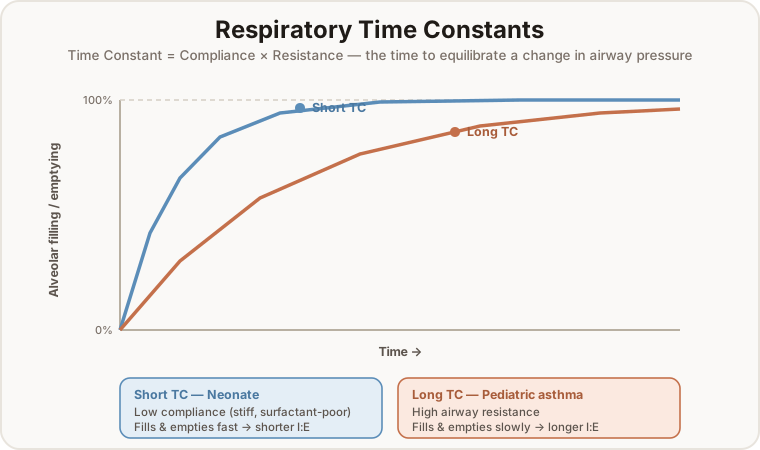
The product of compliance and resistance gives the respiratory time constant — the time necessary for the equilibration of a change in airway pressure.
TC = C × R
| Patient | Lung characteristic | Time constant | Implication |
|---|---|---|---|
| Neonate (stiff lungs, low surfactant) | Low compliance | Short | Lungs fill and empty faster → shorter I:E ratios |
| Pediatric (asthma, high resistance) | High resistance | Long | More time to fill/empty → longer inspiratory and expiratory times |
Infant Ventilators
Historically, neonatal ventilators are continuous flow, pressure-limited, and time-cycled. This has changed as ventilators can now identify tiny flow changes via a pneumotachograph.
A pneumotachograph detects flow changes proximal to the airway, allowing flow triggering for even the smallest infants. Breaths are controlled by volume or pressure.
Initial Application
Infant and pediatric patients are at variable levels of lung development. Each has a different set of volumes and pressures matching their particular lung development.
- Using bag-mask ventilation with a manometer (Jackson-Reese / flow-inflating bag), you can visualize the pressure needed to oxygenate the patient during resuscitation.
- When you bag the patient, you can feel the difference in compliance.
- Recognize the specific disease process and adjust tidal volumes and I:E ratios to match ventilator needs.
Neonatal guidelines are straightforward (based on condition/disease), while pediatric guidelines vary by hospital because pediatric development differs across age groups.
Conventional Ventilator Settings
PIP — Peak Inspiratory Pressure
- Use the pressure required to move the patient's chest during bag-mask ventilation.
- PIP should not exceed 30 cmH₂O — higher levels cause ventilator-induced lung injury.
- This rule CAN be broken in cases of premature birth or chest-wall rigidity due to fentanyl infusion.
PEEP
Your baseline pressure above zero, used to prevent alveolar collapse and maintain lung recruitment.
- Too low → decreased FRC, V/Q mismatch, hypoxemia.
- Too high → overdistension and lung injury.
- Initially set between 4–6 cmH₂O (higher may be used), in conjunction with PIP.
- The difference between PIP and PEEP is the delta P (ventilation pressure). Increasing or lowering delta P increases or decreases tidal volume.
Tidal Volume
| Lung status | Tidal volume |
|---|---|
| Normal lung function | 6–8 mL/kg |
| ARDS / lung injury | 4–5 mL/kg |
Rate
- 40–60/min is normal for neonates; 20–60/min depending on the age of the child.
- Rates should be based on the desired PaCO₂.
- Some permissive hypercapnia is allowed, depending on the hospital.
Inspiratory Time (I-time)
- 0.2–0.4 sec for neonates.
- Up to 1 second for pediatrics.
- Based on the patient's disease process.
Oxygen Concentration
- Keep as low as possible — the immature neonatal lung is particularly susceptible to O₂ toxicity (the immune system cannot defend against super-oxidants).
- Maintain premature-infant saturation 88–95% to prevent retinopathy of prematurity (ROP).
AARC Indications & Hazards for Intubation
Indications
- Apnea
- Hypoxemia (PaO₂ < 50 mmHg)
- Hypercapnia (pH < 7.20–7.25)
- Acidosis despite CPAP with supplemental oxygen
- RDS
- Neurological compromise
- Congenital issues
Hazards / Contraindications
- Air leak syndromes secondary to barotrauma and volutrauma
- Chronic lung disease associated with PPV and O₂ toxicity
- Airway complications (tracheomalacia, air leak, subglottic stenosis)
- Increased WOB
- Pneumonias
- Decreased venous return
Air Leak Syndromes
A term describing problems that occur when air collects within the chest but outside the normal air cells of the lungs. The air then creates pressure on the lungs and makes breathing very difficult. Several air leak syndromes can affect the neonate — pneumothorax, pneumomediastinum, and PIE — and they are more likely in underdeveloped lungs.
Monitoring & Assessment of Outcome
Monitoring
- O₂ and CO₂ monitoring.
- PaO₂ > 40 mmHg and < 70 mmHg to prevent ROP.
- PaCO₂ maintained at levels that keep pH above 7.25.
Assessment of Outcome
- Reduction in WOB
- Radiographic evidence of improved lung volumes
- Subjective improvement in lung volumes
- Improved gas exchange — maintain PaO₂ > 50 mmHg with FiO₂ < 60%, and reverse respiratory acidosis to > 7.25