Sinus, Atrial & Junctional Rhythms
Objective 1.1.3 — Identify sinus, atrial, and junctional rhythms on a rhythm strip, including criteria, common causes, and the basic treatment approach.
This lesson is the rhythm catalog. Every rhythm here is identified by walking through the 5-step method from Lesson 2 and matching the answers to a known pattern. We'll focus on what makes each rhythm unique — the one or two findings that separate it from its neighbors.
Recap — The 5-Step Method
| Step | Question |
|---|---|
| 1 | What's the rate? (six-second method, 300 ÷ large boxes, 1500 ÷ small boxes, triplicate 300/150/100/75/60/50) |
| 2 | Is the rhythm regular? (R-R or P-P variation > 4 small boxes / 0.16 s = irregular) |
| 3 | Are P waves present, before every QRS, and all the same? |
| 4 | Is the PR interval 0.12 – 0.20 s and constant? |
| 5 | Is the QRS ≤ 0.11 s (narrow) or > 0.11 s (wide)? |
See Lesson 2 for the full math behind each rate-calculation method.
Intrinsic pacemaker rates: SA node 60–100 · AV junction 40–60 · ventricular/Purkinje 20–40.
Sinus Rhythms — General Characteristics
A normal heartbeat starts in the SA node and travels the normal conduction pathway.
ECG hallmarks of a sinus-origin rhythm:
- Positive P wave before each QRS complex
- P waves that look alike (uniform morphology)
- Consistent PR intervals
- Regular atrial and ventricular rhythm (usually)
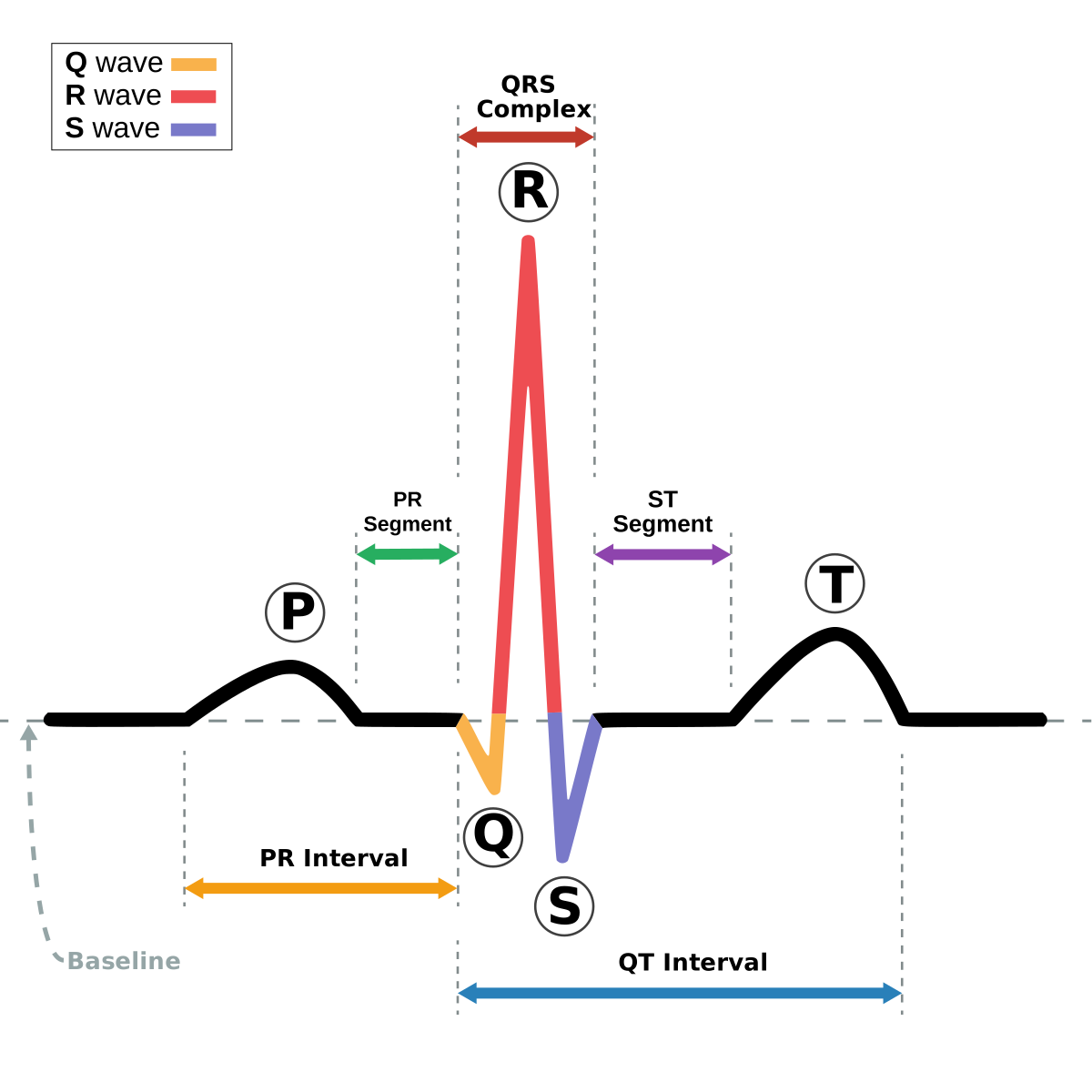
Normal Sinus Rhythm (NSR)
| Parameter | Criteria |
|---|---|
| Rate | 60 – 100 bpm |
| Rhythm | P-P regular, R-R regular |
| P waves | Positive/upright in lead II; one before each QRS; all alike |
| PR interval | 0.12 – 0.20 s, constant beat-to-beat |
| QRS duration | ≤ 0.11 s |
Sinus Bradycardia
| Parameter | Criteria |
|---|---|
| Rate | < 60 bpm |
| Rhythm | P-P regular, R-R regular |
| P waves | Positive/upright in lead II; one before each QRS; all alike |
| PR interval | 0.12 – 0.20 s, constant |
| QRS duration | ≤ 0.11 s |
Common settings:
- Adults and children during sleep
- Well-conditioned athletes
- Present in up to 35% of people under 25 while at rest
Sinus Tachycardia
If the SA node fires faster than normal for the patient's age. Begins and ends gradually. At very fast rates it may be hard to distinguish a P wave from a T wave; the QT interval normally shortens as the heart rate increases.
| Parameter | Criteria |
|---|---|
| Rate | 101 – 180 bpm |
| Rhythm | P-P regular, R-R regular |
| P waves | Positive/upright in lead II; one before each QRS; all alike |
| PR interval | 0.12 – 0.20 s (may shorten with faster rates), constant |
| QRS duration | ≤ 0.11 s |
Common causes:
- Exercise
- Fever
- Pain
- Fear or anxiety
- Hypoxia
Sinus Arrhythmia
The SA node fires irregularly — R-R intervals vary by ≥ 0.16 seconds (more than 4 small boxes).
| Parameter | Criteria |
|---|---|
| Rate | 60 – 100 bpm |
| Rhythm | Irregular |
| P waves | Positive/upright in lead II; one before each QRS; all alike |
| PR interval | 0.12 – 0.20 s, constant |
| QRS duration | ≤ 0.11 s |
When the rate is slower than normal it's called sinus brady-arrhythmia; when faster, sinus tachy-arrhythmia.
Two flavors
- Respiratory sinus arrhythmia — tied to phases of respiration and changes in intrathoracic pressure. Heart rate increases gradually during inspiration and decreases with expiration. Most often seen in children and adults under 30.
- Non-respiratory sinus arrhythmia — seen in older individuals and those with heart disease; may be due to medication effects.
Sinus Arrest / Pause
The SA node fails to generate an impulse, and no escape pacemaker (AV junction or ventricles) takes over when it should. The result is absent PQRST complexes for one or more beats.
| Parameter | Criteria |
|---|---|
| Rate | Usually normal; varies due to the pause |
| Rhythm | Irregular; the pause is of undetermined length and not the same distance as other P-P intervals (because PQRST complexes are missing) |
| P waves | Positive/upright in lead II; one before each QRS; all alike (when present) |
| PR interval | 0.12 – 0.20 s, constant |
| QRS duration | ≤ 0.11 s |
Common causes:
- Hypoxia
- Myocardial ischemia
- Myocardial infarction
Atrial Rhythms — General Characteristics
An irritable site within the atria discharges before the next SA node impulse is due. The ectopic P wave can look very different from a sinus P wave.
ECG features the P wave may show:
- Biphasic (partly positive, partly negative)
- Flattened
- Notched
- Pointed
- Lost in the preceding T wave
Premature-Beat Patterns
These patterns describe how often premature beats fall — and apply equally to atrial, junctional, and ventricular ectopy.
| Pattern | Definition |
|---|---|
| Couplet | 2 premature beats in a row |
| Run / Burst | 3 or more premature beats in a row |
| Bigeminy | Every other beat is a premature beat |
| Trigeminy | Every third beat is a premature beat |
| Quadrigeminy | Every fourth beat is a premature beat |
Premature Atrial Complex (PAC)
A single ectopic atrial beat that interrupts the underlying sinus rhythm.
| Parameter | Criteria |
|---|---|
| Rate | Usually within normal range; depends on underlying rhythm |
| Rhythm | Regular with premature beats |
| P waves | Premature, positive (upright) in lead II, one before each QRS; differs in shape from sinus P waves |
| PR interval | Normal or prolonged depending on prematurity |
| QRS duration | Usually ≤ 0.11 s, but may be wide or absent depending on prematurity; usually similar in shape to the underlying rhythm unless aberrantly conducted |
Common causes:
- Atrial enlargement
- Emotional stress
- Electrolyte imbalance
- Stimulants (caffeine, tobacco, cocaine)
Multiformed Atrial Rhythm (MAR)
Formerly known as Wandering Atrial Pacemaker. The pacemaker site shifts between the SA node, ectopic atrial sites, and the AV junction, so P-wave morphology changes from beat to beat.
| Parameter | Criteria |
|---|---|
| Rate | Usually 60 – 100 bpm; may be slow |
| Rhythm | May be irregular as the pacemaker site shifts |
| P waves | Size, shape, and direction vary beat to beat — at least 3 different P-wave configurations required |
| PR interval | Variable |
| QRS duration | Usually ≤ 0.11 s |
Common causes:
- Digitalis toxicity
- Observed in healthy patients (athletes in particular)
- May be observed during sleep
Multiformed Atrial Tachycardia (MAT)
MAR with a ventricular rate > 100 bpm. Also known as chaotic atrial tachycardia. May be a precursor to atrial fibrillation.
| Parameter | Criteria |
|---|---|
| Rate | > 100 bpm |
| Rhythm | May be irregular as the pacemaker site shifts |
| P waves | Size, shape, and direction vary — at least 3 different P-wave configurations |
| PR interval | Variable |
| QRS duration | Usually ≤ 0.11 s |
Common causes:
- Severe COPD (classic)
- Acute coronary syndromes
- Hypokalemia
- Hypomagnesemia
Supraventricular Tachycardia (SVT)
An umbrella term for any tachycardia that begins above the bifurcation of the bundle of His — at the SA node, atrial tissue, or AV junction. SVT typically occurs at rest and is often paroxysmal ("paroxysmal" = starts or ends suddenly, e.g., PSVT, PAT).
Three SVT mechanisms
| Mechanism | Description |
|---|---|
| AT (Atrial Tachycardia) | An irritable atrial site fires automatically at a very rapid rate |
| AVNRT (AV Nodal Reciprocating Tachycardia) | Impulse moves in a reciprocating loop around the AV node / junctional area |
| AVRT (AV Re-entrant Tachycardia) | Impulse begins above the ventricles but travels through an ectopic accessory pathway — causes pre-excitation of the ventricles |
SVT criteria
| Parameter | Criteria |
|---|---|
| Rate | 150 – 250 bpm |
| Rhythm | Typically regular |
| P waves | May or may not be present (often buried in the preceding T wave); if visible, differ in shape/size from sinus P waves |
| PR interval | If present, < 0.12 s; may be hard to measure |
| QRS duration | Usually ≤ 0.11 s |
Common causes:
- Excessive catecholamine release
- Digitalis toxicity
- Electrolyte imbalance
- Heart disease
- Stimulants (caffeine, albuterol, cocaine)
Wolff-Parkinson-White (WPW) Syndrome
The most common type of pre-excitation syndrome. An accessory pathway lets the impulse bypass the AV node, pre-exciting the ventricles. Usually seen when the patient is not having tachycardia — most often manifests when it triggers AVRT. Noted to occur with atrial fibrillation. Most common cause of tachydysrhythmias in infants and children, with cases leading to sudden cardiac death.
Classic WPW triad on ECG
- Delta wave (slurred upstroke at the start of the QRS)
- Short PR interval
- Widened QRS complex
| Parameter | Criteria |
|---|---|
| Rate | Usually 60 – 100 bpm if underlying rhythm is sinus |
| Rhythm | Regular, unless associated with atrial fibrillation |
| P waves | Normal and positive in lead II (unless WPW is associated with A-fib) |
| PR interval | If present, < 0.12 s |
| QRS duration | Usually > 0.12 s; slurred upstroke (delta wave) in one or more leads |
Common causes:
- Believed to be congenital
- More common in men than in women
Atrial Flutter (A-Flutter)
An ectopic atrial rhythm in which an irritable site fires regularly at an extremely rapid rate. Usually paroxysmal but occasionally lasts hours. The ECG hallmark is a "saw-tooth" or flutter-wave baseline.
Two types
| Type | Mechanism / rate |
|---|---|
| Type I | Re-entry — impulse circles around a large area of tissue (e.g., right atrium); atrial rate 250 – 350 bpm |
| Type II | "Atypical" or "very rapid" atrial flutter; mechanism not yet defined; atrial rate 340 – 450 bpm. Patients with Type II often develop atrial fibrillation. |
| Parameter | Criteria |
|---|---|
| Atrial rate | 250 – 450 bpm, typically 300 bpm |
| Ventricular rate | Variable, determined by AV blockade; usually does not exceed 180 bpm (intrinsic AV junction conduction limit) |
| Rhythm | Atrial regular; ventricular regular or irregular depending on AV conduction/blockade |
| P waves | No identifiable P waves — saw-toothed flutter waves present |
| PR interval | Not measurable |
| QRS duration | ≤ 0.11 s, may be widened if flutter waves are buried in the QRS |
Common causes:
- Cardiac surgery
- Cardiomyopathy
- Pericarditis
- Myocarditis
Atrial Fibrillation (A-Fib)
Caused by altered automaticity in one or several rapidly firing atrial sites, or re-entry involving one or more atrial circuits. Atrial sites fire at 400 – 600 bpm, causing the atrial muscles to quiver rather than contract effectively. Pooled blood in the atria can form clots → embolic stroke risk.
ECG hallmark: fibrillatory waves (a "squiggly" baseline) with QRS complexes scattered on top.
| Parameter | Criteria |
|---|---|
| Atrial rate | 400 – 600 bpm |
| Ventricular rate | Variable: controlled < 100 bpm · uncontrolled > 100 bpm |
| Rhythm | Ventricular rhythm is irregularly irregular |
| P waves | No identifiable P waves — fibrillatory waves; erratic, wavy baseline |
| PR interval | Not measurable |
| QRS duration | ≤ 0.11 s unless an intraventricular conduction delay exists |
Common causes — usually occurs with known cardiovascular disease:
- CAD
- Hypertension
- Cardiomyopathy
- Alcohol abuse
- Obesity
- Medication side effects (antihistamines, beta-agonists, local anesthetics)
Treatment — Atrial Rhythms
- Correct the underlying cause
- Consult cardiology
- Provide supplemental O₂ for symptomatic patients
- Synchronized cardioversion for persistent SVT / SVT-type dysrhythmias
- Adenosine for narrow-complex SVT
- Anticoagulation for A-fib present ≥ 48 hours (clot/stroke risk)
Junctional Rhythms — General Characteristics
When the AV junction (AV node and non-branching portion of the bundle of His) paces the heart, the impulse must travel backward (retrograde) to depolarize the atria. If a P wave is seen, it will be inverted in leads II, III, and aVF because the impulse moves away from the positive electrode.
This is a slower mechanism than sinus or atrial pacing — intrinsic junctional rate is 40 – 60 bpm.
ECG hallmark — P waves are inverted, retrograde (after the QRS), or missing.
Premature Junctional Complex (PJC)
A single early junctional beat that interrupts the underlying (typically sinus) rhythm. Because conduction through the ventricles proceeds normally, the QRS is usually narrow (≤ 0.11 s). Most patients are asymptomatic.
| Parameter | Criteria |
|---|---|
| Rate | Usually within normal range; depends on underlying rhythm |
| Rhythm | Regular with premature beats |
| P waves | May occur before, during, or after the QRS; if visible, inverted in II, III, aVF |
| PR interval | If P is before the QRS: ≤ 0.12 s; if no P before QRS: no PR interval |
| QRS duration | Usually ≤ 0.11 s unless aberrantly conducted or an intraventricular conduction delay exists |
Common causes:
- Digitalis toxicity
- Electrolyte imbalance
- Stimulants
- Acute coronary syndromes
Junctional Escape Beat (JEB) & Escape Rhythm
Unlike PJCs, junctional escape beats occur late — after the next expected sinus beat fails to come. Several sequential junctional escape beats form a junctional escape rhythm.
Patients may be asymptomatic or experience dizziness or syncope related to the slow rate.
| Parameter | Criteria (Junctional Escape Rhythm) |
|---|---|
| Rate | 40 – 60 bpm |
| Rhythm | Very regular |
| P waves | May occur before, during, or after the QRS; if visible, inverted in II, III, aVF |
| PR interval | If P is before the QRS: ≤ 0.12 s; if no P before QRS: no PR interval |
| QRS duration | Usually ≤ 0.11 s |
Common causes:
- Acute coronary syndromes
- Medication effects (beta-blockers, digitalis, diltiazem)
- Hypoxia
- SA node disease
Accelerated Junctional Rhythm
An ectopic rhythm caused by enhanced automaticity of the bundle of His, producing a regular ventricular response above the intrinsic junctional rate but not yet tachycardic. Same criteria as a junctional escape rhythm except for increased rate.
| Parameter | Criteria |
|---|---|
| Rate | 61 – 100 bpm |
| Rhythm | Very regular |
| P waves | May occur before, during, or after the QRS; if visible, inverted in II, III, aVF |
| PR interval | If P before QRS: ≤ 0.12 s; if not: no PR interval |
| QRS duration | Usually ≤ 0.11 s |
Common causes:
- Acute MI
- Digitalis toxicity
- Hypokalemia
Junctional Tachycardia
An ectopic rhythm originating in the pacemaker cells of the bundle of His. Three or more sequential PJCs at a rate > 100 bpm.
| Parameter | Criteria |
|---|---|
| Rate | 101 – 180 bpm |
| Rhythm | Very regular |
| P waves | May occur before, during, or after the QRS; if visible, inverted in II, III, aVF |
| PR interval | If P before QRS: ≤ 0.12 s; if not: no PR interval |
| QRS duration | Usually ≤ 0.11 s |
Common causes:
- Acute coronary syndromes
- Digitalis toxicity
- Side effects of certain medications
Treatment — Junctional Rhythms
- Correct the underlying cause
- Consult cardiology
- Provide supplemental O₂ for symptomatic patients (slow or fast rates)
- Temporary pacemaker (transcutaneous pacing) for slow junctional rhythms
- Adenosine for persistent junctional tachycardia (JT)
High-Yield Recap
Sinus rhythms — what changes vs NSR?
| Rhythm | Distinguishing finding |
|---|---|
| NSR | 60–100 bpm, regular, normal sinus features |
| Sinus brady | < 60 bpm, otherwise NSR |
| Sinus tachy | 101–180 bpm, gradual onset/offset, PR may shorten |
| Sinus arrhythmia | Irregular R-R (> 4 small boxes / 0.16 s); often respiratory |
| Sinus arrest/pause | Missing PQRST, pause is undetermined and not a multiple of P-P |
Atrial rhythms — quick differentiator
| Rhythm | Distinguishing finding |
|---|---|
| PAC | Premature P, different shape from sinus P |
| MAR | ≥ 3 different P-wave morphologies, rate 60–100 |
| MAT | MAR + rate > 100 (think severe COPD) |
| SVT | 150–250 bpm, P waves often buried in T |
| WPW | Delta wave + short PR + wide QRS |
| A-flutter | Saw-tooth flutter waves; atrial 250–450 (typically 300) bpm |
| A-fib | Irregularly irregular; fibrillatory baseline, no P waves; stroke risk |
Junctional rhythms — by rate
| Rhythm | Rate |
|---|---|
| Junctional escape | 40 – 60 bpm |
| Accelerated junctional | 61 – 100 bpm |
| Junctional tachycardia | 101 – 180 bpm |
All junctional rhythms share the same P-wave story: inverted in II, III, aVF, or missing, or after the QRS. PR (when present) is ≤ 0.12 s. QRS is usually narrow.
Premature-beat patterns
| Pattern | Frequency |
|---|---|
| Couplet | 2 in a row |
| Run / burst | ≥ 3 in a row |
| Bigeminy | Every other beat |
| Trigeminy | Every 3rd beat |
| Quadrigeminy | Every 4th beat |
Treatment shortcuts
| Situation | First-line |
|---|---|
| Narrow-complex SVT | Adenosine |
| Persistent SVT-type dysrhythmias | Synchronized cardioversion |
| A-fib ≥ 48 h | Anticoagulation |
| Persistent junctional tachycardia | Adenosine |
| Slow junctional rhythm | Transcutaneous pacing |